The Yizkor Book Project as we know it today came about because of at least four incidents of serendipity.
Serendipity I
Len Markowitz posted a message on the JewishGen list on October 18, 1994, which ignited a huge response. In it he expressed his frustration that translations of yizkor books into English were not available. A discussion between Leonard and Martin Kessel began, soon joined by others. Martin suggested that “perhaps we could begin to assemble a database of Yizkor books that have been translated privately by individuals. As a second step, we can contact fellow genealogists from our shtetls and offer to share the cost of translation.” He offered to help with the project, making many suggestions about databases and collaborations. Because of the volume of mail flooding the JewishGen List, Susan King offered to set up a Yizkor List on November 12, 1994. The group became a SIG — one of the first JewishGen SIGs, it seems. Leonard Markowitz headed the group and informally reported to Bernie Kouchel, a JewishGen board member.
The initial group pondered the administrative issues of the evolving project — who pays for translation costs, how copyright issues would be addressed, what would be shared — in lively postings. As originally conceived, translations would be shared privately and not put on the Internet; the thought then was that “fair use” would cover only the table of contents being posted online. Martin was primarily interested in creating databases and Susannah Juni was involved in developing the translations project. Because of his concern with the legal issues of posting translations online, and the mixed reactions he received from attorneys, Leonard cautiously tabled translations.
The genealogical information in the yizkor books — approximately 1,200 of them — could not be unlocked until these books, usually written in Hebrew or Yiddish, were translated into English, the primary language of most JewishGen researchers at the time. The conundrum was how to stay within legal bounds: it was imperative that permission from the copyright holders be secured before translations could be started and put online. That was the daunting task that stalled the desire to open a light on these valuable books.
Martin Kessel recalls that, under Leonard's overall direction, the Yizkor Book SIG had several distinct projects, as explained in his January 27, 1996 update:
- Database #1, headed by Martin, was a database of researchers interested in particular yizkor books who might cooperate on creating translations.
- Database #2 was originally intended as a repository of yizkor book translations, but was abandoned temporarily because of copyright concerns.
- Database #3, headed by Ray Stone, listed all known yizkor books and other books relating to European Jewish communities.
- Database #4, also headed by Ray, listed major library holdings of yizkor books.
- Infofile #1, headed by Selma Neubauer, was a list of libraries with collections of more than 25 yizkor books.
- Infofile #2, headed by Ray, was a list of retail establishments that sold yizkor books.
- Infofile #3, headed by Len, was a list of translators able to translate yizkor books from Yiddish or Hebrew into English.
In February 1996, Martin took over as head of the SIG, as Leonard had new responsibilities as president of the Jewish Genealogical Society of Philadelphia and with the JewishGen Advisory Board.
During this period, Michael Tobias created automated e-mail systems that could search various JewishGen databases: patrons typed search parameters into an e-mail message, and the JewishGen server e-mailed back the results. Martin felt a web-based search system was the wave of the future, and enlisted his wife's cousin, Eric Rose, to design one. After several months of testing, the search system was announced to JewishGen users in February 1996 and became JewishGen's first web-based search engine. Because some users still lacked web access, Michael Tobias designed a parallel e-mail search engine, which went online in March.
The three separate databases were eventually merged into one consolidated database, in which the table of Yizkor Books was linked to the table of Contact Persons and to the Library Call Numbers. By this time Michael Tobias was designing web-based search engines for many other JewishGen databases, and in July 1998 he created a new search engine for the consolidated Yizkor Book database.
Serendipity II
A number of problems had to be solved before a translation project could begin. Martin Kessel managed the Yizkor Book Project at the time (February 1996 – October 2000), and his major duties involved administering the databases. Susannah Juni, who had little free time, was nevertheless handling the nascent translations project, which through 1996 had no online translations.
On April 9, 1996, Susannah Juni wrote to the Yizkor Book SIG with an ambitious proposal: to raise funds to translate all known yizkor books and make the translations available to the public. She was convinced the copyright impasse could be overcome. A CPA who knew a number of attorneys with expertise in copyright, she worked with JewishGen's pro-bono attorney, who wrote a clear policy on how JewishGen would make the best possible effort — documented “due diligence” — to contact the original publishers of yizkor books or their successors. A set of legal forms and disclaimers to appear on all web pages was also developed.
While the copyright issues were being resolved, Susannah collected important information on the yizkor book publication committees, variant legal forms and requirements, and other administrative procedures without which the translation project could not move forward. She also researched various incomplete translations that individuals had undertaken for their own personal use, often covering only references to their own family and only on paper. What became evident was that people could not afford to hire a professional to translate an entire book — but that by pooling the resources of many individuals with an interest in the same town, tax-deductible funds donated to a non-profit, JewishGen, Inc., could pay for a professional translator.
Serendipity III
Early in 1996 Susannah and Joyce Field discovered each other through the Family Finder and an article in the Gesher Galicia newsletter. They shared an unknown common ancestor named Kestenbaum from Stanislawow (now Ivano-Frankivsk), and during their exchange of emails and phone calls they decided there were too many coincidences for them not to be related. They agreed to share resources for the translation of the Stanislawow yizkor book. As Susannah's time was increasingly stretched, Joyce offered to coordinate the translation project. What emerged became the model for JewishGen's future online translation project, and Stanislawow was the first translation to go online, in October 1997.
As the Stanislawow translation moved along, Susannah concluded that the project was too time-consuming for her, as she was deeply involved in planning a trip to Ukraine, and asked Joyce to take over as Translations Manager. Joyce agreed, not foreseeing what might be involved — and was completely shocked when FedEx shortly thereafter dropped two massive boxes of Susannah's files on her front porch, so heavy she couldn't lift them upstairs to her study.
Serendipity IV
As she worked through those files and tried to develop implementation plans, Joyce realized that a critical part of the project was getting permission from the landsmanschaftn that had published the yizkor books, most of them in Israel. The Holocaust survivors who had written the histories of their towns were, by the mid-1990s, quite elderly and unfamiliar with computers and the Internet. Most could not read or write English, so the overriding issue was how best to reach them, explain the project, and secure their written permission — on forms written in English — to put the translations online. The most efficient way seemed to be to find someone in Israel who could phone them, put them at ease with friendly conversation, and explain the mysteries of the Internet so they would feel comfortable with JewishGen's efforts. It was also vital to overcome their reluctance to see work made available to a worldwide audience, since they had written these books for very limited distribution, just to preserve their memories; many felt no one was interested in their books about the destroyed communities of Europe.
As she was thinking about how to do this, Joyce posted a message on the JewishGen Digest asking for help finding the telephone number of a friend in Israel. The first person to respond was Lance Ackerfeld. During subsequent exchanges she intuitively realized he could be the right person to help secure permissions. He accepted the challenge and, as they say, the rest is history. Without Lance to secure permission from the landsmanschaftn, the project would never have developed.
Historical Milestones
The translation project kept growing, stretching available human resources. Martin Kessel needed help with HTML and with the technical work of getting translations online and linked. Staff came to include John Berman, Mike Kalt, Carol Monosson Edan, Jerry Esterson, Moshe Shavit, and many others who helped short-term, and Michael Tobias, who helped with online linkages. Lance volunteered as an HTML-er as well, and Max Heffler and Osnat Ramaty later joined that group. When it was decided to include graphic images from the yizkor books, Osnat learned how and became the graphic-image maven. By May 2004, 9,139 graphic images were online; by the end of 2008, when counting stopped, the number had grown to 14,745.
On October 5, 1998, a year after the announcement of the Ivano-Frankivsk translation, 41 translations were online and 10 more were being prepared, giving 50 translations in the project's first year. Another first-anniversary milestone was the database of Shoah victims from Nuremberg, Germany — a notable collaboration between the U.S. Holocaust Memorial Museum (represented by Peter Lande), Gerhard Jochem of the Nuremberg Archives, who spearheaded it and wrote a brilliant introduction, and Michael Tobias of JewishGen, who built the search engine. This was the precursor of many collaborations between the Yizkor Book Project and the USHMM, and it prompted thinking about a Holocaust database and a necrology database of the names listed in the yizkor books.
In August 1998, JewishGen recognized that the Yizkor Book SIG had outgrown its status as a Special Interest Group, and renamed it the Yizkor Book Project to clarify its status as an integral part of JewishGen.
On May 28, 1999, Joyce posted a message announcing that the 100th translation had been uploaded. When she assumed the position of Translations Manager she had set a personal goal of reaching 100 translations in two years — a goal reached in 20 months. On September 12, 1999, Susan King focused on the Yizkor Book Project in her L'Shana Tova message to the JewishGen family, praising the effort and enumerating its accomplishments.
Many changes came early in 2000. On July 1, 2000, Martin resigned as Project Manager due to time constraints, and Joyce Field assumed that role in addition to Translations Manager. John Berman, Webmaster until early 2000, stepped down, and Lance Ackerfeld added Webmaster duties to his other roles. Harriet Brown wore many hats: moderating the discussion group, responding to public inquiries, updating the InfoFiles, and expanding the library call numbers in the database.
Late in June 2000, the data-sharing agreement with Yad Vashem was signed, leading to significant collaboration between Yad Vashem and JewishGen's Holocaust Database and Yizkor Book Project, particularly the Necrology Database; the announcement was made at the IAJGS Conference in Salt Lake. In August 2000, JewishGen and the USHMM developed an informal agreement on procedures for collaboration that would benefit all JewishGen projects. In December 2000, the Yizkor Book Necrology Database went online, thanks to the diligent work of Ernest Fine and Max Heffler.
In August 2002, the Yizkor Book Project received the IAJGS award for Outstanding Contributions to Jewish Genealogy.
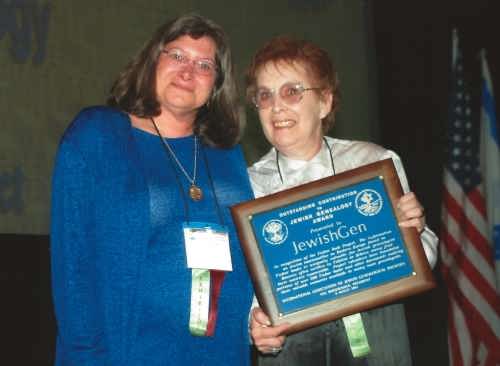
Joyce Field retired at the end of 2008 (Avraham Groll managed the project on an interim basis), and Lance Ackerfeld became Project Manager in July 2009. Other notable achievements of the first decade of the century were the linkage of the Yizkor Book Database to online yizkor book images at the New York Public Library, the linkage of the database to the WorldCat (OCLC) bibliographic database, and the Yizkor Book Master Name Index, managed by Osnat Hazan, which went live in July 2010.
Early on, the project decided that many significant works might not fall under the traditional definition of “yizkor” books but were historically important enough to belong online; as there was no other home for them, a “Miscellaneous” category was created. As requests came in for yizkor books translated into languages other than English, an “Other Languages” category was created as well. Due to growing interest in purchasing hard copies of completely translated books, the Yizkor Books in Print Project was set up in April 2011 by Joel Alpert, to prepare a professionally formatted print-on-demand version of the online presentation.
The overall achievements of the Yizkor Book Project are shown in the charts below:
These achievements were made possible by some important decisions made early on:
- When it became apparent that our audience eagerly expected the online translations to reveal names — of residents, of notable people from the town, and of those who perished in the Holocaust — and that translating entire books quickly would be prohibitively expensive, we encouraged each project's coordinators to start with the table of contents and the necrologies and get those online as soon as possible, so landsleit could search for the names of their relatives.
- The second decision was to allow each chapter's translation to go online as soon as it was ready. One didn't have to wait for the entire book. Because translating a book takes many years, coordinators know they are making a long-term commitment.
- The third decision was to establish fundraising projects under the aegis of JewishGen to hire professional translators. Each coordinator could decide whether to use volunteers or to hire a professional; if the latter, the coordinator was responsible for raising the tax-deductible funds.
The Yizkor Book Project always tried to be flexible rather than rigid, putting online material that would be significant to family researchers regardless of whether it was a “traditional” yizkor book — including research documents on Belzec, Holocaust memoirs, chapters from the Pinkas HaKehillot, Galician Jewish celebrities, and Oskar Schindler.
The project has been enormously successful and popular with genealogical researchers. Many libraries have told us that before it began, family researchers would beg librarians for translations of yizkor books so they could understand how their ancestors had lived and learn the names of the martyrs; the librarians could not help. Now they can point to the Yizkor Book site on JewishGen, where researchers can learn online how their families lived and died.
© Joyce Field, March 2012
Yizkor Book Director: Lance Ackerfeld. Emerita Yizkor Book Project Manager: Joyce Field z”l.