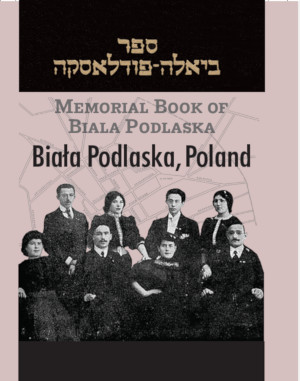
Sefer Biala Podlaska
Editor of Original Yizkor Book: M. J. Feigenbaum Project Coordinator: Max Wald Cover Design: Irv Osterer Layout: Jonathan Wind Name Indexing: Stefanie Holzman 8.5” x 11” hard cover 730 pages with original photographs
About This Book
An epic record of the rise and eventual ruin of the Jewish Community of Biala Podlaska, this sweeping Yizkor Memorial Book traces the town's chaotic journey through history. Founded at the end of the 15th century in the Lithuanian state, it subsequently moved between Poland and Austria in the early 19th century, and finally shuttled between Russia, Germany and back to Poland in the years surrounding the World Wars.
As early as 1621, there was evidence of a well-established Jewish settlement of about 30 families in Biala. From the beginning there were conflicts between the Christian and Jewish populations regarding dwelling rights, trade, employment and taxation, battles that would last for generations.
Restricted by profession, the Biala Jewish income earners were tradesmen, primarily tailors and cap-makers but also lace makers, goldsmiths, bookbinders, metal workers and butchers. They had no influence on the administration of the town. Their lives were centered around the Rabbi's courtyard, in Chassidic prayer houses and in trading businesses with the surrounding landowners.
By the end of the 19th century, changes in Jewish life began to be noticeable. A sector of Jewish youth began to secretly study worldly subjects and a dispute with the religious circle began. During the German occupation of the first World War, though the economy was in ruin and the Jewish masses impoverished, groups like the Zionists and the Bund - a Jewish socialist party that promoted the autonomy of Jewish workers – helped to foster an upturn in cultural, political and social aspects. Several new institutions were created, among them a Hebrew school, Children's Home and library. Many religious Jews lost their zeal to fight the trend toward enlightenment as they became increasingly defeated by poverty.
With the advent of World War II and the arrival of the Gestapo, the Jews of Biala struggled for daily existence. The products of hatred and war wrought forced labor, economic strangulation, deportation, camps and ultimate annihilation. When liberation by the Russian army came in July of 1944, the entire Jewish community of Biala Podlaska had been erased. Thanks to the historians, researchers, authors and eyewitnesses whose years of painstaking work live within these pages, their lives will never be forgotten.
Place Details
Alternate names:Biała Podlaska [Pol], Podlyashe [Yid], Litvish Biale [Yid], Biala Gadol [Heb], Biala, Biala D'Lita
Biała Podlaska, Poland is located at 52°02' N 23°08' E and 92 miles E of Warszaw
Nearby Jewish Communities:
Łomazy 9 miles S
Łosice 22 miles NW
Piszczac 12 miles ESE
Kodeń 22 miles ESE
Janów Podlaski 12 miles NNE
Sarnaki 22 miles NNW
Rossosz 13 miles S
Brest, Belarus 25 miles E
Konstantynów 13 miles N
Wohyń 25 miles SW
Międzyrzec Podlaski 15 miles WSW
Vysokaye, Belarus 25 miles NNE
Wisznice 17 miles SSE
Sławatycze 26 miles SE
Komarówka Podlaska 18 miles SSW
Damachava, Belarus 28 miles SE
Niemirów 18 miles N
Radzyń Podlaski 28 miles SW
Terespol 19 miles E
Chernavchitsy, Belarus 28 miles ENE
Volchin, Belarus 19 miles NNE
Mordy 29 miles WNW
Mielnik 21 miles N
Parczew 29 miles SSW
Zbuczyn 30 miles W