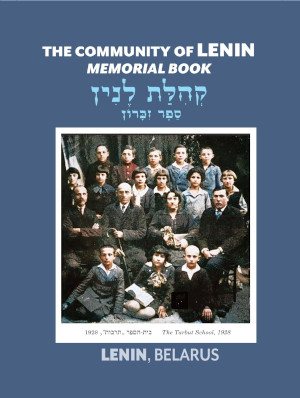
Kehilat Lenin; Sefer Zikaron
Editor of Original Yizkor Book: M. Tamari Project Coordinator: Sanford A. Kaplan z”l Formatting, layout and name indexing: Jonathan Wind Cover Design: Irv Osterer Book Summary: Bruce Drake Hard Cover 8.5" x 11", 530 pages with original photographs
About This Book
Lenin was a small shtetl now located in southern Belarus about 50 miles east of Pinsk and close to Ukraine's northern border. At various times it was part of the Polish-Lithuanian Commonwealth, the Russian empire, the reconstituted Polish republic between the world wars and then the Soviet Union until Belarus became an independent nation in 1991. The Jewish population was 753 in the Russian census of 1897, rising to 928 in 1921.
The main occupation of the Jewish population was crafts: there were cobblers, tailors, carpenters, ironsmiths and later there were some shopkeepers, mostly grocers. Forest and lumber-related occupations also played a key role in the economy. But Lenin Jews – with very few exceptions – lived a difficult life, hemmed in by a lack of industry in the region and restrictions on livelihoods and landownership, particular in the times of the Russian Czar.
The town was situated in a region of forests and marshes. The area was prone to flooding when rainy autumns and melting winter snows caused the Pripet River to flood, cutting off connections to other towns. The book describes what this setting meant in the town center which was located in an area so muddy that all of the sand wagons that stumbled in it were not able to manage. Even during the summer, when the land had dried up around it, the mud reached to the knees. On the main street, a walkway made of thick wooden planks was constructed leading from one end of the street to the other, and ditches were dug on both sides.
The sanitary situation was less than ideal. Houses, clustered in a small space surrounded by water and swamps, did not have the necessary sanitary facilities Pigs and goats wandered through the street, going wherever they wanted to. Epidemics were common.
Following World War one, Lenin became part of the reborn Poland and its Jews endured lawlessness and violence, often at the hands of gangs comprised of liberated Polish soldiers. In 1939, the Soviets annexed eastern Poland, including Lenin, but two years later, the Nazis invaded and occupied the town. Most of the Jewish population was murdered in 1942.
Place Details
Alternate names for the town:
Lenin [Rus, Bel, Yid, Pol], Lenino
Lenin, Belarus is located at 52°20' N 27°29' E 48 miles S of Slutsk
Nearby Jewish Communities:
Mikashevichi 8 miles S
Zhytkavichy 18 miles ESE
Lakhva 18 miles WSW
Skavshin 20 miles NE
Remel 21 miles SSW
Turov 21 miles SSE
Kazhan-Haradok 21 miles WSW
Davyd-Haradok 23 miles SSW
Starobin 28 miles N
Luninyets 29 miles WSW